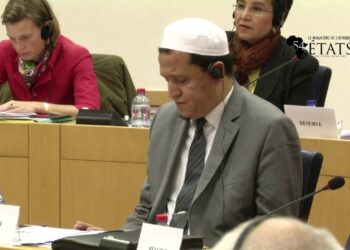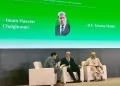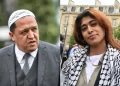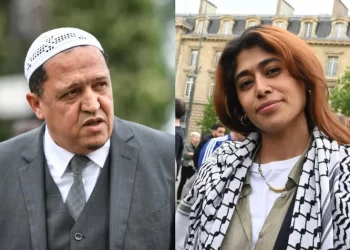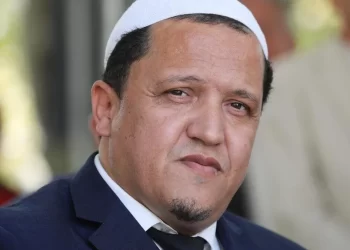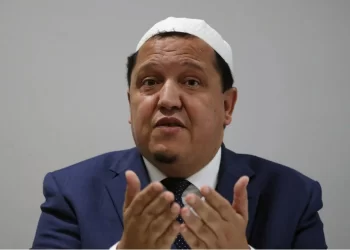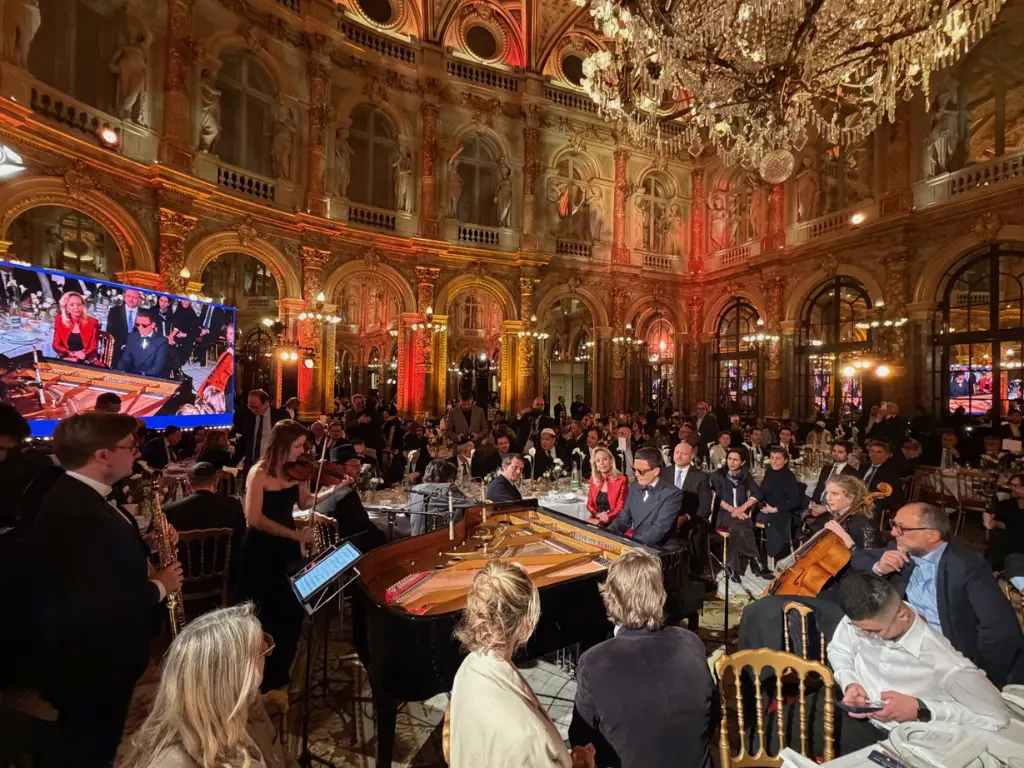
There are sometimes evenings which, beyond their apparent conviviality, take on an unexpected political and symbolic dimension. The “Iftar for Peace” organized in Paris by Imam Hassan Chalghoumi and entrepreneur, pianist and composer Omar Harfouch, undoubtedly belongs to this category. On Tuesday, March 10, 2026, more than four hundred personalities, politicians, diplomats, intellectuals and business leaders met at the InterContinental to break the fast of Ramadan in a spirit that we would like to see more often at work: that of the dialogue of civilizations and resistance to obscurantism.
On the stage, three flags alone summed up the spirit of the evening: the French flag, the European flag and the American flag. Three symbols of a democratic West which, despite its contradictions and weaknesses, remains one of the last spaces where freedom of conscience, religious plurality and criticism of fanaticism can still be expressed without trembling. At a time when identity tensions are sharpening and radical Islamism continues to sow fear, the initiative led by Hassan Chalghoumi and Omar Harfouch deserves to be welcomed. It reminds us that another Islam exists, an Islam of peace, responsibility and civic courage.
Because it takes courage, today, to clearly denounce Islamist fundamentalism. It takes courage to affirm that religion must never become a political instrument or an ideological weapon. And it takes courage to confront the intimidation of those who claim to speak for millions of believers while betraying the spiritual essence of their faith.
It is in this context that the iftar for peace awarded its annual prize to the President of the United States, Donald Trump. A gesture that is obviously not trivial. For some, it will seem provocative. For others, paradoxical. But for the organisers, it is part of a clear geopolitical reading: that of a leader who assumes a policy of firmness in the face of Islamist terrorism and initiated the Abraham Accords, those of normalization between Israel and several Arab countries. While perhaps one day waiting for the honors of the Nobel Peace Prize, it was the United States ambassador to France, Charles Kushner, who came to receive this distinction. In the presence of the Israeli ambassador to France, Joshua Zarka, the French minister Mathieu Lefèvre, imams and rabbis from all over Europe.
During the evening, tensions in the Middle East were also discussed with gravity. The attacks attributed to Iran against the United Arab Emirates, Bahrain, Oman and Qatar have been unanimously denounced. In a region already scarred by decades of conflict, hegemonic ambitions and strategies of destabilization only fuel instability. Here again, the appeal launched from Paris was clear: peace is not only decreed by speeches, it requires actions, alliances and constant political will.
The evening was punctuated by an artistic note with the recital of Omar Harfouch, performing his concerto for peace. Music, this universal language that crosses cultures and religions, seemed to remind everyone that peace is never an abstraction. It is patiently built, between diplomacy and culture, between political courage and human fraternity.
In a fractured world, where extremism often thrives on fear and resignation, the iftar for peace will at least have had the merit of reminding us of an obvious fact that is too often forgotten: peace between peoples and civilizations is not a slogan. It’s a fight. And like all struggles for freedom, it requires voices that dare to speak and men who dare to act.